Architecture · Portability
Portability
Cortex runs entirely on portable primitives: containers, PostgreSQL, a Redis-protocol cache, object storage, OIDC and OTLP.
- Portable computeContainers on Kubernetes
- Standard statePostgreSQL, Redis protocol, and object storage
- Open interfacesOIDC identity and OTLP telemetry


Portable platform primitives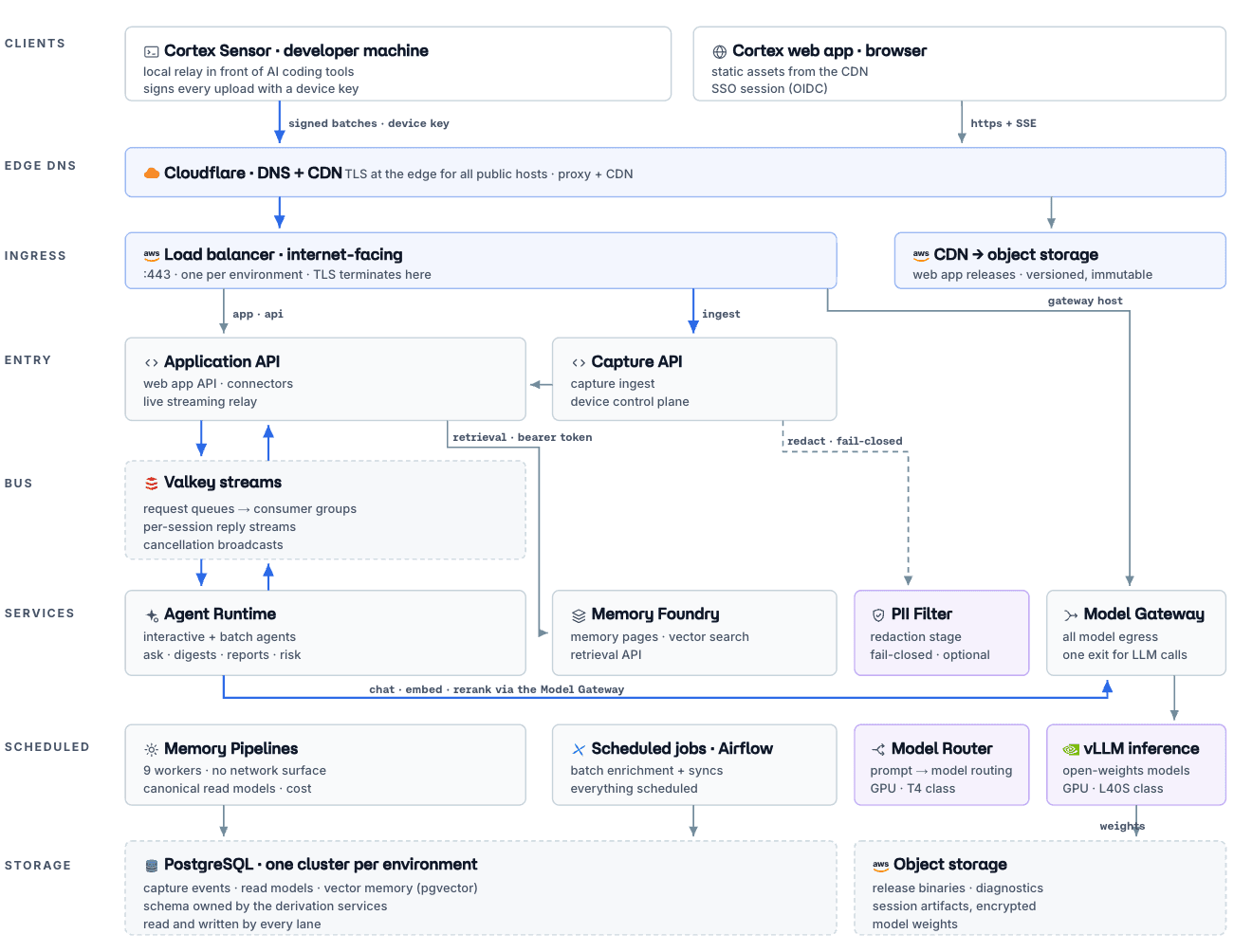
Cortex is built on portable primitives, not proprietary managed services. Every dependency has a widely available equivalent on any major cloud.
The primitives
| Primitive | Role |
|---|---|
| Containers on Kubernetes | Every workload, deployed declaratively |
| PostgreSQL + pgvector | Every durable fact, including vector memory |
| Redis-protocol cache | Streams, cache and rate limits |
| Object storage | Releases, artifacts and model weights |
| OIDC | Single sign-on against your identity provider |
| OTLP | Traces and metrics to any observability backend |
Why a move is mechanical
- Every workload is a container deployed by declarative Terraform and Helm configuration; nothing is hand-built.
- The web app is a static React bundle on any CDN; there is no server rendering to migrate.
- State lives in exactly three places — PostgreSQL, the cache and object storage — all standard protocols.
- Identity is plain OIDC, so any compliant issuer is a drop-in.
- GPU workloads run on ordinary GPU node pools; models are open-weights and travel as files in object storage.
Was this helpful?