Architecture · Platform
Containers and data paths
Every Cortex service, layer by layer, and the two hot paths that carry the platform: capture ingest and agent streaming.
- Layered servicesClients, edge, entry, services, scheduled work, and storage
- Capture ingestSigned batches become structured provider events
- Agent streamingValkey streams carry live requests and replies


Containers and data paths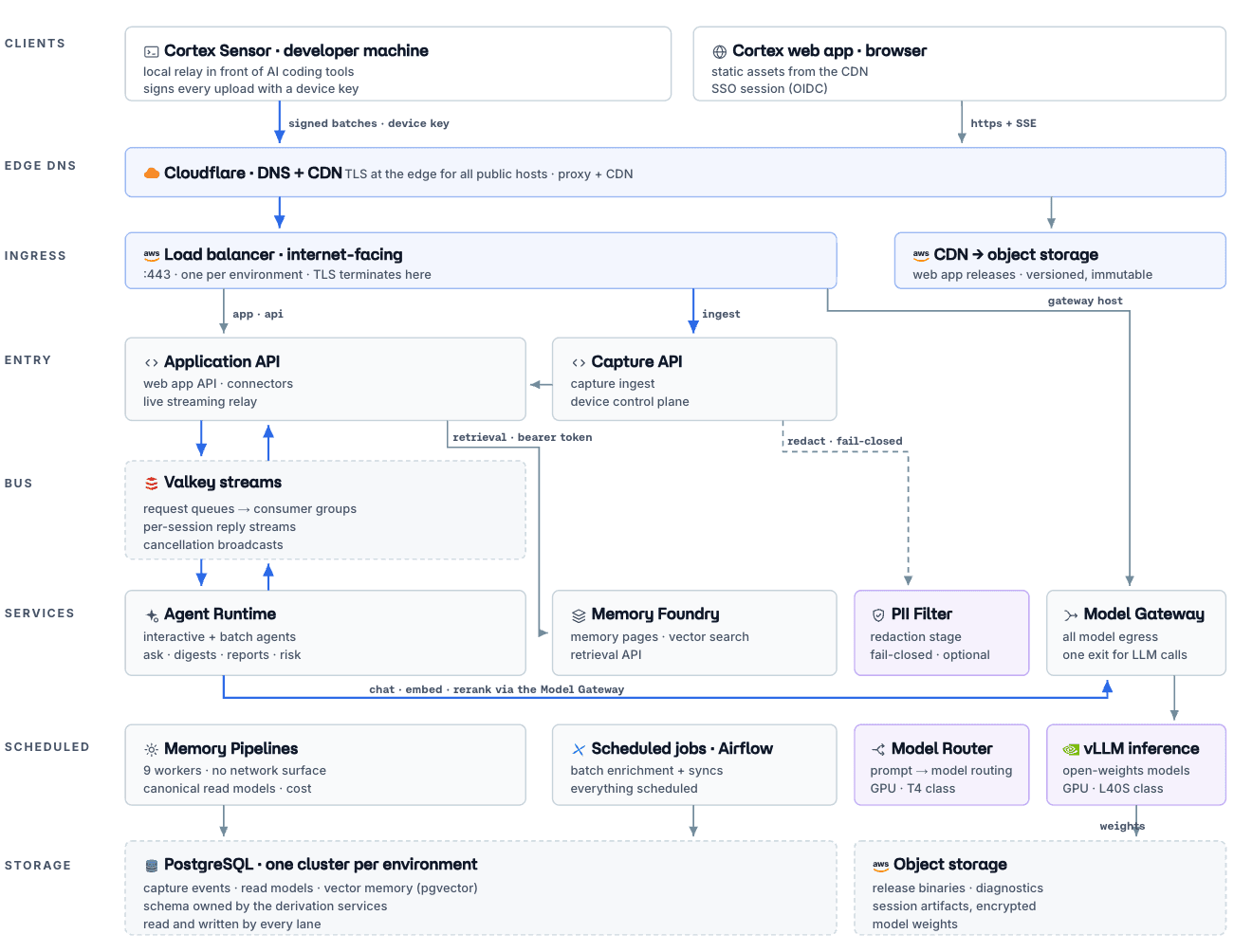
Flow runs top to bottom: clients, edge, entry services, the streaming bus, internal services, the scheduled plane, storage. Blue paths are the two hot paths — capture ingest and agent streaming.
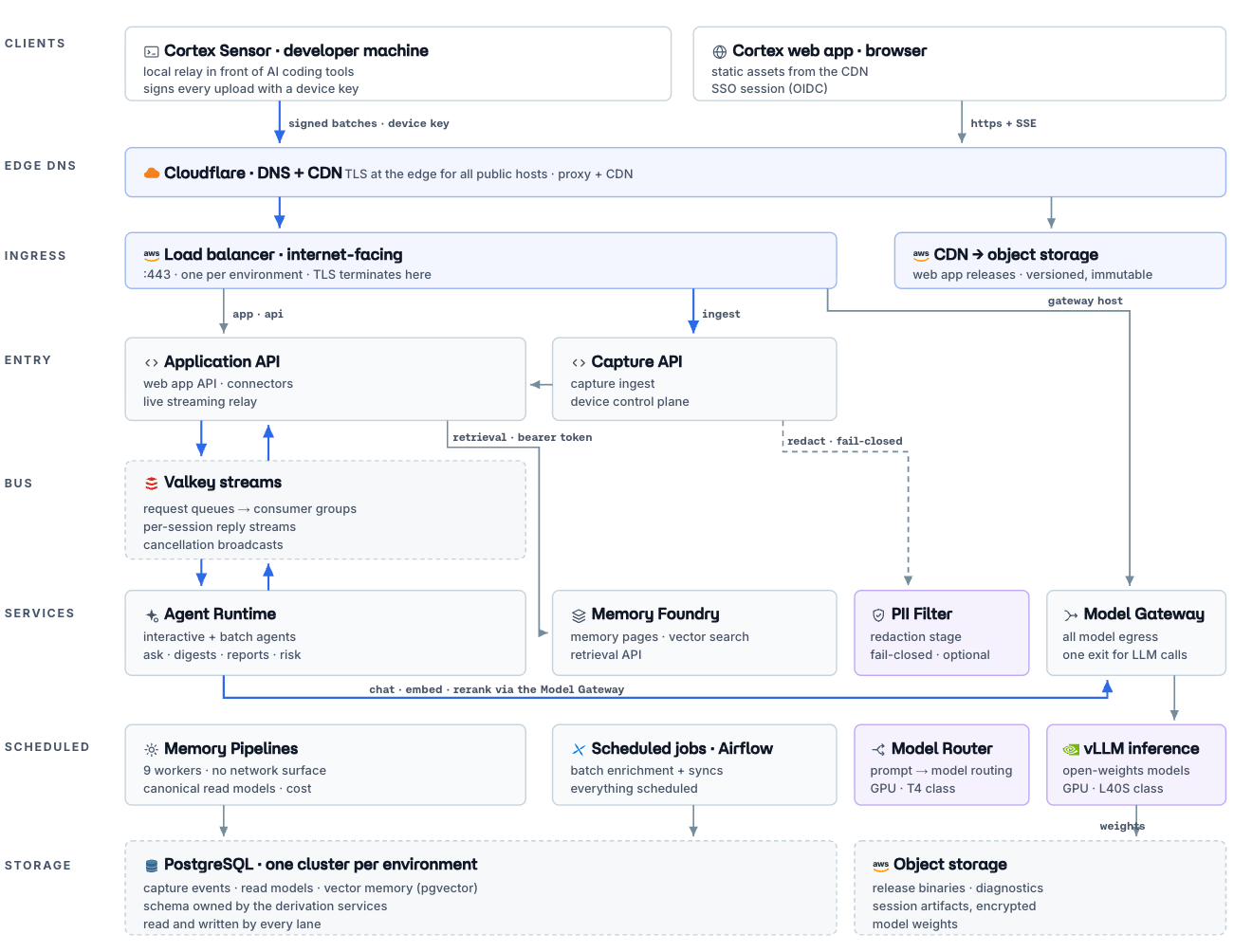
The layers
| Layer | What lives there |
|---|---|
| Clients | The Cortex Sensor on each developer machine and the Cortex web app in the browser |
| Edge | DNS, CDN and TLS for all public hosts |
| Entry | The Application API (web app, API, live streaming relay) and the Capture API (capture ingest, device control plane) |
| Bus | Valkey streams: request queues, per-session reply streams, cancellation broadcasts |
| Services | The Agent Runtime, Memory Foundry, the optional PII redaction stage, and the Model Gateway — the single exit for model calls |
| Scheduled | Memory Pipelines, scheduled jobs, model routing and open-weights inference |
| Storage | PostgreSQL (one cluster per environment) and object storage |
Hot path 1: capture ingest
1
The Sensor batches captured activity locally and uploads it as signed batches.
2
The Capture API verifies each batch and writes structured provider events to PostgreSQL.
3
Derivation lanes pick the events up from there — no broker in the batch path.
Hot path 2: agent streaming
1
The browser opens a streaming session against the Application API.
2
The Application API places the request on a Valkey stream; the Agent Runtime consumes it.
3
The Agent Runtime streams the reply back over a per-session stream; the Application API relays it to the browser as server-sent events.
4
Model calls made along the way leave through the Model Gateway only.
Everything else is plain HTTP between named internal services.
Was this helpful?